

Redefining Quality Assurance Through Continuous Improvement
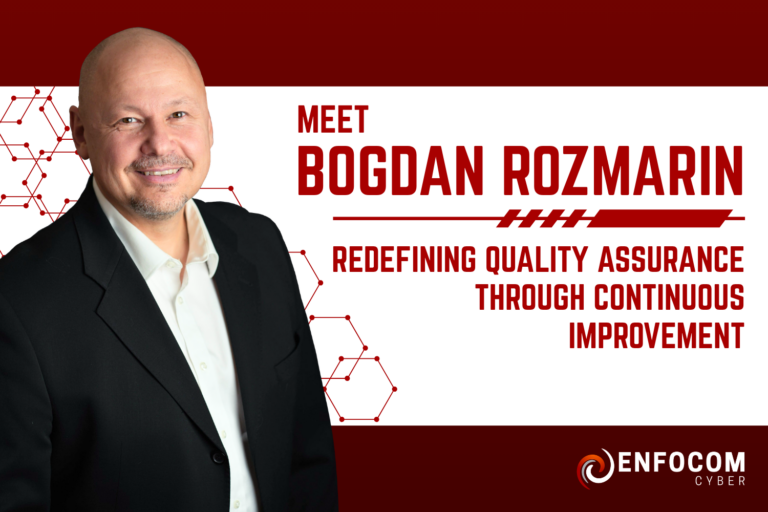
It’s easy to assume that software quality assurance (QA) is simply the process of testing software and searching for bugs before a product is released. However, according to ENFOCOM Cyber’s Senior Software Quality Assurance Lead, Bogdan, modern QA is about much more than just testing – it’s about building quality into every stage of the software development process.
“My role goes beyond testing,” Bogdan explains. “I work closely with development teams, external clients, and stakeholders to build quality into every stage of the software development lifecycle.”
That collaborative approach is what drives his work every day. As a QA Lead, he helps define quality strategies and testing standards, manages test plans and execution, identifies risks, tracks quality metrics, and supports teams in continuously improving how they deliver software. Ultimately, his goal is to help teams deliver better products faster while maintaining a strong focus on customer satisfaction and business needs.
Quality Starts Before the Code
One of the biggest misconceptions about quality assurance, Bogdan says, is that QA begins once development is complete. In reality, modern QA professionals are involved from the very beginning of a project. This includes reviewing requirements, identifying potential risks, and participating in design discussions to assess risks and helping determine how a product should be tested.
“The value of QA isn’t just finding defects,” he says. “It’s being proactive in identifying high-risk areas, validating requirements, and making sure what we’re building meets the needs of the people who will actually use it.”
This proactive approach also challenges another common misconception: that QA slows down development. While testing and quality processes require time, effective QA can ultimately help teams move faster by identifying issues earlier, reducing rework, and giving teams greater confidence when releasing software.
Automation is another area where misconceptions can arise. Although automated testing can significantly reduce repetitive work, Bogdan emphasizes that it doesn’t eliminate the need for QA professionals. Critical thinking, understanding business requirements, exploratory testing, and risk analysis still require human judgment.
In other words, QA is not simply about finding what went wrong. It is about asking the right questions before problems happen and helping teams understand what quality should look like for the people using the product.
Using Artificial Intelligence as an Assistant
As artificial intelligence continues to transform software development, Bogdan sees significant opportunities for AI to support QA professionals and make quality processes more proactive.
AI can assist with tasks such as generating test cases, analyzing requirements, identifying coverage gaps, detecting patterns in defects, predicting release risks, and supporting test automation. But Bogdan sees even greater potential in bringing together the large amount of information software teams already produce. Source code repositories, Jira tickets, release notes, test results, production incidents, and customer feedback can all provide valuable insights. By analyzing these sources together, AI could help teams identify areas that are more likely to contain defects, highlight technical debt, recommend testing priorities, and even predict potential risks in an upcoming release.
Rather than spending time on repetitive tasks, teams could use these insights to focus their time and resources where they will have the greatest impact. However, he emphasizes that AI still requires human oversight. AI can generate test cases and identify potential risks, but its suggestions still need to be reviewed and validated. As Bogdan puts it during our conversation, “garbage in, garbage out.” The quality of the information provided to an AI system directly affects the quality of what it produces.
“AI won’t replace QA professionals,” Bogdan says. “It will allow them to focus more on strategic quality decisions, risk management, user experience, and business value. I see AI becoming an intelligent assistant that helps teams make faster and better-informed decisions”
Quality is Everyone’s Responsibility
While QA may have a specific role in maintaining software quality, Bogdan believes that responsibility ultimately belongs to the entire team.
“We’re all responsible for quality,” he says. “If you see something there, you say, ‘Hey, this doesn’t look great. How can we fix it?’ That’s part of building better software. The goal is not perfection – it’s continuous improvement.”
This idea is closely connected to Bogdan’s approach to process improvement. Rather than only addressing individual defects, he believes teams should look at why problems occur and how their processes can be improved to prevent similar issues in the future. That can mean refining requirements, improving sprint planning, expanding automation, reducing bottlenecks, or finding better ways for teams to collaborate. Tools such as Jira can also help by providing visibility into requirements, tasks, defects, releases, and project progress. But as Bogdan points out, technology alone doesn’t solve workflow problems. The right tools need to be paired with clear communication, effective processes, and a willingness to improve.
His approach also recognizes that quality can mean different things to different people. A product may meet one person’s expectations while falling short of another’s. That is why understanding the requirements and needs of the people using the product is such an important part of QA.
Beyond The Workplace
Bogdan’s commitment to continuous improvement extends beyond software development. Outside of ENFOCOM, he teaches karate, an experience that has given him another perspective on leadership, learning, and helping others grow.
“I was drawn to the challenge, discipline, and continuous learning that karate offers,” he says. “What keeps me engaged is the ongoing opportunity to improve and help others grow.”
For Bogdan, teaching has become just as rewarding as practicing the martial art itself. One of the most meaningful parts of being an instructor is seeing students accomplish something they once believed was beyond their abilities and gain confidence along the way.
The experience has also influenced how he approaches leadership at work. Teaching different students requires patience, communication, and the ability to adapt your approach depending on the individual. Those same skills can be valuable when working with colleagues and helping team members develop their own abilities.
“Many of the lessons from martial arts – discipline, adaptability, respect, resilience, and continuous improvement – translate directly into leadership and professional environments,” Bogdan explains.
That mindset also contributes to his desire to continue learning throughout his career. His growing interest in cybersecurity is a natural extension of his work in software quality, particularly as organizations increasingly rely on AI and automation. Bogdan is particularly interested in secure software development, application security, and the role AI can play in threat detection and risk management. He believes security should be integrated throughout the software development lifecycle rather than treated as a final checkpoint.
Looking Ahead
Across his work in QA, his growing interest in cybersecurity, and his experience teaching karate, Bogdan’s approach to life and work is guided by the same principle: there is always an opportunity to learn, adapt, and improve.
For him, continuous improvement is about staying curious, taking on new challenges, and using each experience as an opportunity to grow. Whether he is helping a team deliver better software, or mentoring a student, Bogdan continues to look for ways to learn and help others along the way.
As he looks toward the future, he hopes to continue exploring the intersection of AI, software quality, and cybersecurity while sharing what he learns with those around him. His advice to those beginning their own careers reflects the mindset that has shaped his journey: “Stay curious, seek challenges, learn continuously, and focus on building both technical expertise and strong relationships.” To him, the path forward is all about continuing to learn, improve, and find new ways to help others perform at their best.