

Building a Stronger Foundation for Cybersecurity Compliance
Cybersecurity is about more than protecting networks and responding to threats. For organizations working with sensitive information, strong cybersecurity also means having the right policies, processes, and controls in place to demonstrate that information can be protected.
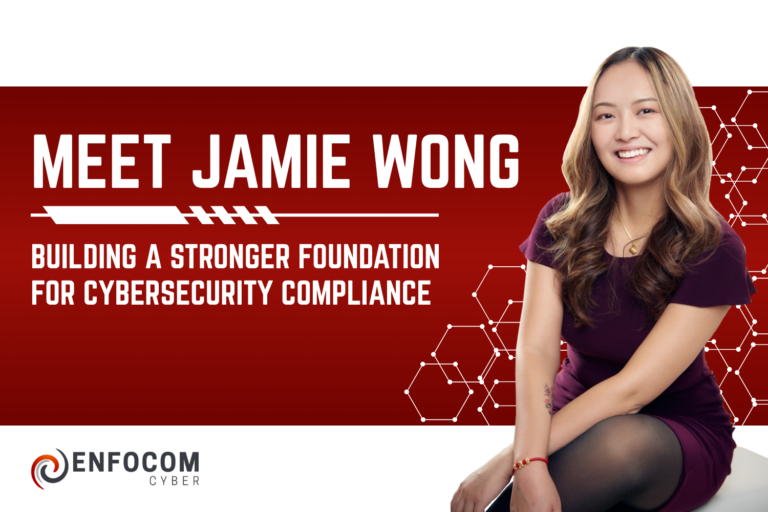
At ENFOCOM Cyber, Jamie Wong, our Senior Information Security Analyst, plays an important role in that process. Her work spans developing security policies, cybersecurity compliance, law enforcement training, and National Cybersecurity Consortium (NCC) initiatives. From helping strengthen ENFOCOM’s security practices to contributing to projects designed to contribute to cybersecurity across Canada, Jamie’s work focuses on building the foundation organizations need to stay secure.
Preparing for Defence-Level Cybersecurity
A significant part of Jamie’s work involves researching and preparing for cybersecurity certifications, including the Cybersecurity Maturity Model Certification (CMMC) and the Canadian Program for Cyber Security Certification (CPCSC).
CMMC is a U.S. cybersecurity certification designed for organizations working with the U.S. defence industry, while CPCSC is Canada’s corresponding program. Both are particularly relevant for organizations seeking military and defence contracts, where contractors may be responsible for protecting sensitive government information
For Jamie, these certifications are about more than simply meeting a requirement.
“Government agencies and defence contractors need to know that the organizations they award contracts to can properly protect the information they’re entrusted with,” she explains.
Becoming compliant requires organizations to understand the controls they need to meet, develop and implement the appropriate policies, and demonstrate that those security measures are actually in place. That process is part of Jamie’s current work at ENFOCOM, where she is helping develop and review security policies while working through feedback and making improvements.
Cybersecurity Compliance & Why it Matters
The importance of this work has grown alongside the changing nature of cyber threats. As governments, defence organizations, and critical infrastructure become increasingly dependent on digital systems, protecting information and essential services has become an important part of security. This change is a reason why cybersecurity has become such a priority.
“It’s not necessarily physically fighting a war,” she explains. “A lot of it is also cybercrime.”
Cyberattacks can be used to target organizations, disrupt critical infrastructure, and compromise sensitive information. For organizations working with government and defence partners, strong cybersecurity practices help demonstrate that they can be trusted with information that needs to be protected. However, compliance shouldn’t be viewed simply as a checklist.
“I think people need to put more emphasis on why it’s important,” she says.
This is where cybersecurity compliance provides an important foundation. Having established cybersecurity frameworks can help organizations understand where their security practices stand and identify areas for improvement.
Bridging Cybersecurity & Law Enforcement
Jamie also brings her security and compliance expertise to ENFOCOM’s NCC projects, where she is currently contributing to two projects: IncidentSync & CyberGuardian.
IncidentSync focuses on developing an incident response framework that can work alongside existing frameworks such as NIST and ISO. Rather than replacing those frameworks, the project aims to address gaps in how organizations and law enforcement interact during cybersecurity incidents. These gaps can include communication challenges, uncertainty around when law enforcement should become involved, and a lack of understanding about what happens once they do.
Jamie is helping to facilitate focus groups with collaborators and develop the early drafts of the frameworks.
“It’s more so a framework that’s going to be used or supplemented along with already existing frameworks,” she explains. “It’s going to be working alongside it to address gaps.”
CyberGuardian focuses specifically on cybersecurity training for law enforcement. This project aims to address cybersecurity knowledge gaps among officers, particularly those that may not have much experience in cybersecurity. The long-term goal is to develop a standardized training curriculum that can eventually be delivered across Canada through different institutions and collaborators.
Jamie is helping establish the groundwork for that curriculum by looking at training gaps, identifying what law enforcement needs to learn, and considering how different modules and stages of training could fit together.
Jamie’s experience with cybersecurity frameworks allows her to approach these projects from an organizational security perspective while working alongside law enforcement experts.
“I can kind of bridge the two worlds together,” Jamie says.
That perspective is particularly valuable for initiatives that bring cybersecurity organizations and law enforcement together. By understanding both sides, Jamie can help connect organizational security practices with the practical needs of those responding to cyber incidents.
Looking Ahead
As technology continues to evolve, cybersecurity compliance will have to evolve alongside it. For Jamie, Artificial Intelligence (AI) is one area that will create new security considerations for organizations. While she doesn’t expect the fundamental principles of cybersecurity to change dramatically, organizations will need to consider how to ensure new technologies are adopted safely, including what data they have access to and what risks they may introduce.
“How can you be secure even if you decide to use AI?” she asks.
This question reflects a broader challenge in cybersecurity: organizations need to understand not only what new technologies can do, but also how they can use them responsibly and securely. Ultimately, Jamie sees cybersecurity compliance as a starting point for building stronger organizations.
“It’s important at the end of the day to the success of your company, and also to protect yourself.”
Through her work on security policies, defence-focused certifications, and NCC initiatives, Jamie is helping ENFOCOM strengthen its own security foundation.
Learn the Fundamentals
Interested in learning more about policy development?
ENFOCOM, through the CATE Centre in collaboration with the University of Calgary Continuing Education, delivers the Law Enforcement Professional Training Program, including CAT 320: Introduction to Security Policy. This course covers the best practices for developing and implementing cybersecurity policies within an organization. It covers cybersecurity control frameworks, policy and documentation practices, and ensuring compliance with legal requirements.